
easyclimate.field.ocean
Submodules
Functions
|
Calculate the mixed layer depth. |
Calculate the weights of mixed layer depth. The weights required by the ocean model under non-uniform distribution grids in the depth direction. |
|
|
Calculate the tendency of the mixing layer temperature. |
|
Obtain data within the mixed layer. |
|
Obtain seawater temperature data within the mixing layer. |
|
Obtain averaged data within the mixed layer. |
|
Obtain averaged seawater temperature data within the mixing layer. |
|
Obtain the average horizontal advection within the mixed layer |
|
Obtain the average vertical advection within the mixed layer. |
|
Obtain ocean surface heat flux. |
|
Calculate the intensity of the subtropical frontal zone (STFZ). |
|
Calculate the intensity of the subarctic frontal zone (SAFZ). |
|
Calculate the location index of the subtropical frontal zone (STFZ). |
|
Calculate the location index of the subarctic frontal zone (SAFZ). |
|
Calculate the location of the subtropical frontal zone (STFZ). |
|
Calculate the location of the subarctic frontal zone (SAFZ). |
|
Find the index of dim in the xarray DataArray. |
|
Calculate the frequency of seawater buoyancy. |
|
Calculate the potential density of seawater. |
|
Compute the gradient along the coordinate dim direction. |
|
Caculate thermocline depth of ocean temperature. |
|
Caculate value depth of ocean temperature. |
|
Caculate 14m depth of ocean temperature. |
|
Caculate 17m depth of ocean temperature. |
|
Caculate 20m depth of ocean temperature. |
|
Caculate 26m depth of ocean temperature. |
|
Caculate 28m depth of ocean temperature. |
Package Contents
- easyclimate.field.ocean.calc_mixed_layer_depth(seawater_temperature_data: xarray.DataArray, seawater_practical_salinity_data: xarray.DataArray, criterion: {'temperature', 'density', 'pdvar'} = 'pdvar', depth_dim: str = 'depth', lon_dim: str = 'lon', lat_dim: str = 'lat') xarray.DataArray
Calculate the mixed layer depth.
Parameters
- seawater_temperature_data:
xarray.DataArray(\(\mathrm{^\circ C}\)) Vertical seawater temperature data.
- seawater_practical_salinity_data:
xarray.DataArray(\(\mathrm{PSU}\)) Vertical seawater salinity data (practical salinity).
- criterion: {‘temperature’, ‘density’, ‘pdvar’}, default ‘pdvar’.
Mixed layer depth criteria
temperature : Computed based on constant temperature difference criterion, i.e., \(CT(0) - T[mld] = 0.5 \mathrm{^\circ C}\).
density : Computed based on the constant potential density difference criterion, i.e., \(pd[0] - pd[mld] = 0.125\) in sigma units.
pdvar : Computed based on variable potential density criterion \(pd[0] - pd[mld] = var(T[0], S[0])\), where var is a variable potential density difference which corresponds to constant temperature difference of \(0.5 \mathrm{^\circ C}\).
- depth_dim:
str, default: depth. depth like dimension over which to apply calculate. By default extracting is applied over the depth dimension.
- lon_dim:
str, default: lon. Longitude coordinate dimension name. By default extracting is applied over the lon dimension.
- lat_dim:
str, default: lat. Latitude coordinate dimension name. By default extracting is applied over the lat dimension.
Returns
The mixed layer depth (
xarray.DataArray).- seawater_temperature_data:

- easyclimate.field.ocean.calc_MLD_depth_weighted(seawater_temperature_data: xarray.DataArray | xarray.Dataset, mixed_layer_depth: xarray.DataArray, depth_dim: str = 'depth') xarray.DataArray | xarray.Dataset
Calculate the weights of mixed layer depth. The weights required by the ocean model under non-uniform distribution grids in the depth direction.
Parameters
- seawater_temperature_data:
xarray.DataArray(\(\mathrm{^\circ C}\)). Vertical seawater temperature data.
- mixed_layer_depth:
xarray.DataArray(\(\mathrm{m}\)). The mixed layer depth.
- depth_dim:
str, default: depth. depth like dimension over which to apply calculate. By default extracting is applied over the depth dimension.
Returns
The weights of the mixed layer depth (
xarray.DataArrayorxarray.Dataset).- seawater_temperature_data:
- easyclimate.field.ocean.calc_MLD_temper_tendency(seawater_temperature_anomaly_data: xarray.DataArray, mixed_layer_depth: xarray.DataArray, depth_weight: xarray.DataArray, depth_dim='depth', time_dim='time') xarray.DataArray
Calculate the tendency of the mixing layer temperature.
Parameters
- seawater_temperature_anomaly_data:
xarray.DataArray(\(\mathrm{^\circ C}\)). The anomaly of the vertical seawater temperature data.
- mixed_layer_depth:
xarray.DataArray(\(\mathrm{m}\)). The mixed layer depth.
- depth_weight:
xarray.DataArray. The weights of the mixed layer depth. The data is generated by the
easyclimate.field.ocean.mixlayer.calc_MLD_depth_weighted- depth_dim:
str, default: depth. depth like dimension over which to apply calculate. By default extracting is applied over the depth dimension.
- time_dim:
str, default: time. The time coordinate dimension name.
Returns
The weights of the mixed layer depth (
xarray.DataArray).- seawater_temperature_anomaly_data:
- easyclimate.field.ocean.get_data_within_MLD(data_input: xarray.DataArray, mixed_layer_depth: xarray.DataArray, depth_dim: str = 'depth') xarray.DataArray
Obtain data within the mixed layer.
Caution
This function sets the data outside the mixing layer as missing values, i.e. np.nan, but it does not calculate the average value for the data inside the mixing layer.
Parameters
- data_input:
xarray.DataArray. The spatio-temporal data to be calculated.
- mixed_layer_depth:
xarray.DataArray(\(\mathrm{m}\)). The mixed layer depth.
- depth_dim:
str, default: depth. depth like dimension over which to apply calculate. By default extracting is applied over the depth dimension.
Returns
The data within the mixed layer (
xarray.DataArray).- data_input:
- easyclimate.field.ocean.get_temper_within_MLD(seawater_temperature_data: xarray.DataArray, mixed_layer_depth: xarray.DataArray, depth_dim: str = 'depth') xarray.DataArray
Obtain seawater temperature data within the mixing layer.
Caution
This function sets the data outside the mixing layer as missing values, i.e. np.nan, but it does not calculate the average value for the data inside the mixing layer.
Parameters
- seawater_temperature_data:
xarray.DataArray(\(\mathrm{^\circ C}\)) Vertical seawater temperature data.
- mixed_layer_depth:
xarray.DataArray(\(\mathrm{m}\)). The mixed layer depth.
- depth_dim:
str, default: depth. depth like dimension over which to apply calculate. By default extracting is applied over the depth dimension.
Returns
The seawater temperature data within the mixed layer (
xarray.DataArray).- seawater_temperature_data:
- easyclimate.field.ocean.get_data_average_within_MLD(data_input: xarray.DataArray, mixed_layer_depth: xarray.DataArray, depth_weight: xarray.DataArray, depth_dim: str = 'depth') xarray.DataArray
Obtain averaged data within the mixed layer.
Parameters
- data_input:
xarray.DataArray The spatio-temporal data to be calculated.
- mixed_layer_depth:
xarray.DataArray(\(\mathrm{m}\)). The mixed layer depth.
- depth_weight:
xarray.DataArray. The weights of the mixed layer depth. The data is generated by the
easyclimate.field.ocean.mixlayer.calc_MLD_depth_weighted- depth_dim:
str, default: depth. depth like dimension over which to apply calculate. By default extracting is applied over the depth dimension.
Returns
The averaged data within the mixed layer (
xarray.DataArray).- data_input:
- easyclimate.field.ocean.get_temper_average_within_MLD(seawater_temperature_data: xarray.DataArray, mixed_layer_depth: xarray.DataArray, depth_weight: xarray.DataArray, depth_dim: str = 'depth') xarray.DataArray
Obtain averaged seawater temperature data within the mixing layer.
Caution
This function sets the data outside the mixing layer as missing values, i.e. np.nan, but it does not calculate the average value for the data inside the mixing layer.
Parameters
- seawater_temperature_data:
xarray.DataArray(\(\mathrm{^\circ C}\)) Vertical seawater temperature data.
- mixed_layer_depth:
xarray.DataArray(\(\mathrm{m}\)). The mixed layer depth.
- depth_weight:
xarray.DataArray. The weights of the mixed layer depth. The data is generated by the
easyclimate.field.ocean.mixlayer.calc_MLD_depth_weighted- depth_dim:
str, default: depth. depth like dimension over which to apply calculate. By default extracting is applied over the depth dimension.
Returns
The averaged seawater temperature data within the mixed layer (
xarray.DataArray).- seawater_temperature_data:
- easyclimate.field.ocean.calc_MLD_average_horizontal_advection(u_monthly_data: xarray.DataArray, v_monthly_data: xarray.DataArray, seawater_temperature_data: xarray.DataArray, mixed_layer_depth: xarray.DataArray, depth_weight: xarray.DataArray, lon_dim: str = 'lon', lat_dim: str = 'lat', depth_dim: str = 'depth', min_dx: float = 1.0, min_dy: float = 1.0, edge_order: int = 2, R: float = 6371200.0) xarray.DataArray
Obtain the average horizontal advection within the mixed layer
Parameters
- u_monthly_data:
xarray.DataArray(\(\mathrm{m \cdot s^{-1}}\)). The monthly ocean current data.
- v_monthly_data:
xarray.DataArray(\(\mathrm{m \cdot s^{-1}}\)). The monthly meridional ocean current data.
- seawater_temperature_data:
xarray.DataArray(\(\mathrm{^\circ C}\)). Vertical seawater temperature data.
- mixed_layer_depth:
xarray.DataArray(\(\mathrm{m}\)). The mixed layer depth.
- depth_weight:
xarray.DataArray. The weights of the mixed layer depth. The data is generated by the
easyclimate.field.ocean.mixlayer.calc_MLD_depth_weighted- lon_dim:
str, default: lon. Longitude coordinate dimension name. By default extracting is applied over the lon dimension.
- lat_dim:
str, default: lat. Latitude coordinate dimension name. By default extracting is applied over the lat dimension.
- depth_dim:
str, default: depth. depth like dimension over which to apply calculate. By default extracting is applied over the depth dimension.
- min_dx:
float, default: 1.0. The minimum acceptable value of dx, below which parts will set nan to avoid large computational errors. The unit is m. You can set it to a negative value in order to remove this benefit.
- min_dy:
float, default: 1.0. The minimum acceptable value of dy, below which parts will set nan to avoid large computational errors. The unit is m. You can set it to a negative value in order to remove this benefit.
- edge_order: {1, 2}, optional
Gradient is calculated using N-th order accurate differences at the boundaries. Default: 1.
- R:
float, default: 6370000. Radius of the Earth.
Returns
The average horizontal advection within the mixed layer (\(\mathrm{^\circ C} \cdot \mathrm{month}^{-1}\),
xarray.DataArray).- u_monthly_data:
- easyclimate.field.ocean.calc_MLD_average_vertical_advection(w_monthly_data: xarray.DataArray, seawater_temperature_data: xarray.DataArray, mixed_layer_depth: xarray.DataArray, depth_weight: xarray.DataArray, depth_dim: str = 'depth') xarray.DataArray
Obtain the average vertical advection within the mixed layer.
Parameters
- w_monthly_data:
xarray.DataArray(\(\mathrm{m \cdot s^{-1}}\)). The monthly vertical ocean current data.
- seawater_temperature_data:
xarray.DataArray(\(\mathrm{^\circ C}\)). Vertical seawater temperature data.
- mixed_layer_depth:
xarray.DataArray<xarray.DataArray>`(:math:mathrm{m}`). The mixed layer depth.
- depth_weight:
xarray.DataArray. The weights of the mixed layer depth. The data is generated by the
easyclimate.field.ocean.mixlayer.calc_MLD_depth_weighted- depth_dim:
str, default: depth. depth like dimension over which to apply calculate. By default extracting is applied over the depth dimension.
Returns
The average vertical advection within the mixed layer (\(\mathrm{^\circ C} \cdot \mathrm{month}^{-1}\),
xarray.DataArray).- w_monthly_data:
- easyclimate.field.ocean.calc_ocean_surface_heat_flux(qnet_monthly_anomaly_data: xarray.DataArray, mixed_layer_depth: xarray.DataArray | float, rho_0: float = 1000, c_p: float = 4000) xarray.DataArray
Obtain ocean surface heat flux.
Parameters
- qnet_monthly_anomaly_data:
xarray.DataArray(\(\mathrm{W \cdot m^{-2}}\)). The monthly anomaly of the downward net heat flux at the ocean surface.
- mixed_layer_depth:
xarray.DataArray(\(\mathrm{m}\)). The mixed layer depth.
- rho_0:
float, default: 1000 (\(\mathrm{kg \cdot m^{-3}}\)). The density of water.
- c_p:
float, default: 4000 (\(\mathrm{J \cdot kg \cdot K^{-1}}\)). The specific heat of water.
Returns
The ocean surface heat flux (\(\mathrm{^\circ C} \cdot \mathrm{month}^{-1}\),
xarray.DataArray).Reference
Nnamchi, H., Li, J., Kucharski, F. et al. Thermodynamic controls of the Atlantic Niño. Nat Commun 6, 8895 (2015). https://doi.org/10.1038/ncomms9895
- qnet_monthly_anomaly_data:
- easyclimate.field.ocean.calc_intensity_STFZ(sst_DtDy_data: xarray.DataArray, criteria=0.45 * 1e-05, lat_range=[24, 32], lon_range=[145, 215], lat_dim: str = 'lat', lon_dim: str = 'lon') xarray.DataArray
Calculate the intensity of the subtropical frontal zone (STFZ). The intensity index defined reflects an average of the SST meridional gradient within a frontal zone.
\[\mathrm{ITS} = \sum_{i=1}^{N} \frac{G_i}{N}\]where \(G_i\) is the value of zonally-averaged SST meridional gradient that is no less than an empirically-given critical value (here, \(0.45 \times 10^{-5} \mathrm{km^{-1}}\) for STFZ) at the \(i\)-th latitudinal grid point within the zone, and \(N\) is the number of total grid points that satisfy the criteria above.
Parameters
- sst_DtDy_data
xarray.DataArray The SST meridional gradient data.
- criteria:
float, default: 0.45 *1e-5. Empirically-given critical value.
- lat_range:
list, default: [24, 32]. The latitude range of the oceanic frontal zone.
- lon_range:
list, default: [145, 215]. The longitude range of the oceanic frontal zone.
- lat_dim:
str, default: lat. Latitude coordinate dimension name. By default extracting is applied over the lat dimension.
- lon_dim:
str, default: lon. Longitude coordinate dimension name. By default extracting is applied over the lon dimension.
Returns
The intensity of the STFZ (
xarray.DataArray).Reference
Wang, L., Yang, X.-Q., Yang, D., Xie, Q., Fang, J. and Sun, X. (2017), Two typical modes in the variabilities of wintertime North Pacific basin-scale oceanic fronts and associated atmospheric eddy-driven jet. Atmos. Sci. Lett, 18: 373-380. Website: https://doi.org/10.1002/asl.766
- sst_DtDy_data

- easyclimate.field.ocean.calc_intensity_SAFZ(sst_DtDy_data: xarray.DataArray, criteria=0.8 * 1e-05, lat_range=[36, 44], lon_range=[145, 215], lat_dim: str = 'lat', lon_dim: str = 'lon') xarray.DataArray
Calculate the intensity of the subarctic frontal zone (SAFZ). The intensity index defined reflects an average of the SST meridional gradient within a frontal zone.
\[\mathrm{ITS} = \sum_{i=1}^{N} \frac{G_i}{N}\]where \(G_i\) is the value of zonally-averaged SST meridional gradient that is no less than an empirically-given critical value (here, \(0.80 \times 10^{-5} \mathrm{km^{-1}}\) for SAFZ) at the \(i\)-th latitudinal grid point within the zone, and \(N\) is the number of total grid points that satisfy the criteria above.
Parameters
- sst_DtDy_data
xarray.DataArray The SST meridional gradient data.
- criteria:
float, default: 0.80 *1e-5. Empirically-given critical value.
- lat_range:
list, default: [36, 44]. The latitude range of the oceanic frontal zone.
- lon_range:
list, default: [145, 215]. The longitude range of the oceanic frontal zone.
- lat_dim:
str, default: lat. Latitude coordinate dimension name. By default extracting is applied over the lat dimension.
- lon_dim:
str, default: lon. Longitude coordinate dimension name. By default extracting is applied over the lon dimension.
Returns
The intensity of the SAFZ (
xarray.DataArray).Reference
Wang, L., Yang, X.-Q., Yang, D., Xie, Q., Fang, J. and Sun, X. (2017), Two typical modes in the variabilities of wintertime North Pacific basin-scale oceanic fronts and associated atmospheric eddy-driven jet. Atmos. Sci. Lett, 18: 373-380. Website: https://doi.org/10.1002/asl.766
- sst_DtDy_data
- easyclimate.field.ocean.calc_location_STFZ(sst_DtDy_data: xarray.DataArray, criteria=0.45 * 1e-05, lat_range=[24, 32], lon_range=[145, 215], lat_dim: str = 'lat', lon_dim: str = 'lon') xarray.DataArray
Calculate the location index of the subtropical frontal zone (STFZ). The intensity index defined reflects an average of the SST meridional gradient within a frontal zone.
\[\mathrm{LCT} = \sum_{i=1}^{N} (G_i \times \mathrm{LAT}_i) / \sum_{i=1}^{N} G_i\]where \(\mathrm{LAT}_i\) is the latitude at the \(i\)-th grid point within the front zone. Obviously, this definition reflects a weighted-average of \(\mathrm{LAT}_i\) with respect to \(G_i\), indicating that the location of a front is mainly determined by larger SST meridional gradients within the frontal zone.
Parameters
- sst_DtDy_data
xarray.DataArray The SST meridional gradient data.
- criteria:
float, default: 0.45 *1e-5. Empirically-given critical value.
- lat_range:
list, default: [24, 32]. The latitude range of the oceanic frontal zone.
- lon_range:
list, default: [145, 215]. The longitude range of the oceanic frontal zone.
- lat_dim:
str, default: lat. Latitude coordinate dimension name. By default extracting is applied over the lat dimension.
- lon_dim:
str, default: lon. Longitude coordinate dimension name. By default extracting is applied over the lon dimension.
Returns
The location index of the STFZ (
xarray.DataArray).Reference
Wang, L., Yang, X.-Q., Yang, D., Xie, Q., Fang, J. and Sun, X. (2017), Two typical modes in the variabilities of wintertime North Pacific basin-scale oceanic fronts and associated atmospheric eddy-driven jet. Atmos. Sci. Lett, 18: 373-380. Website: https://doi.org/10.1002/asl.766
- sst_DtDy_data
- easyclimate.field.ocean.calc_location_SAFZ(sst_DtDy_data: xarray.DataArray, criteria=0.8 * 1e-05, lat_range=[36, 44], lon_range=[145, 215], lat_dim: str = 'lat', lon_dim: str = 'lon') xarray.DataArray
Calculate the location index of the subarctic frontal zone (SAFZ). The intensity index defined reflects an average of the SST meridional gradient within a frontal zone.
\[\mathrm{LCT} = \sum_{i=1}^{N} (G_i \times \mathrm{LAT}_i) / \sum_{i=1}^{N} G_i\]where \(\mathrm{LAT}_i\) is the latitude at the \(i\)-th grid point within the front zone. Obviously, this definition reflects a weighted-average of \(\mathrm{LAT}_i\) with respect to \(G_i\), indicating that the location of a front is mainly determined by larger SST meridional gradients within the frontal zone.
Parameters
- sst_DtDy_data
xarray.DataArray The SST meridional gradient data.
- criteria:
float, default: 0.80 *1e-5. Empirically-given critical value.
- lat_range:
list, default: [36, 44]. The latitude range of the oceanic frontal zone.
- lon_range:
list, default: [145, 215]. The longitude range of the oceanic frontal zone.
- lat_dim:
str, default: lat. Latitude coordinate dimension name. By default extracting is applied over the lat dimension.
- lon_dim:
str, default: lon. Longitude coordinate dimension name. By default extracting is applied over the lon dimension.
Returns
The location index of the SAFZ (
xarray.DataArray).Reference
Wang, L., Yang, X.-Q., Yang, D., Xie, Q., Fang, J. and Sun, X. (2017), Two typical modes in the variabilities of wintertime North Pacific basin-scale oceanic fronts and associated atmospheric eddy-driven jet. Atmos. Sci. Lett, 18: 373-380. Website: https://doi.org/10.1002/asl.766
- sst_DtDy_data
- easyclimate.field.ocean.calc_location_line_STFZ(sst_DtDy_data: xarray.DataArray, criteria=0.45 * 1e-05, lat_range=[24, 32], lon_range=[145, 215], lat_dim: str = 'lat', lon_dim: str = 'lon') xarray.DataArray
Calculate the location of the subtropical frontal zone (STFZ). The intensity index defined reflects an average of the SST meridional gradient within a frontal zone.
\[\mathrm{LCT} = (\sum_{i=1}^{N} (G_i \times \mathrm{LAT}_i)) / G_i\]where \(\mathrm{LAT}_i\) is the latitude at the \(i\)-th grid point within the front zone. Obviously, this definition reflects a weighted-average of \(\mathrm{LAT}_i\) with respect to \(G_i\), indicating that the location of a front is mainly determined by larger SST meridional gradients within the frontal zone.
Parameters
- sst_DtDy_data
xarray.DataArray The SST meridional gradient data.
- criteria:
float, default: 0.45 *1e-5. Empirically-given critical value.
- lat_range:
list, default: [24, 32]. The latitude range of the oceanic frontal zone.
- lon_range:
list, default: [145, 215]. The longitude range of the oceanic frontal zone.
- lat_dim:
str, default: lat. Latitude coordinate dimension name. By default extracting is applied over the lat dimension.
- lon_dim:
str, default: lon. Longitude coordinate dimension name. By default extracting is applied over the lon dimension.
Returns
The location of the STFZ (
xarray.DataArray).Reference
Wang, L., Yang, X.-Q., Yang, D., Xie, Q., Fang, J. and Sun, X. (2017), Two typical modes in the variabilities of wintertime North Pacific basin-scale oceanic fronts and associated atmospheric eddy-driven jet. Atmos. Sci. Lett, 18: 373-380. Website: https://doi.org/10.1002/asl.766
- sst_DtDy_data
- easyclimate.field.ocean.calc_location_line_SAFZ(sst_DtDy_data: xarray.DataArray, criteria=0.8 * 1e-05, lat_range=[36, 44], lon_range=[145, 215], lat_dim: str = 'lat', lon_dim: str = 'lon') xarray.DataArray
Calculate the location of the subarctic frontal zone (SAFZ). The intensity index defined reflects an average of the SST meridional gradient within a frontal zone.
\[\mathrm{LCT} = (\sum_{i=1}^{N} (G_i \times \mathrm{LAT}_i)) / G_i\]where \(\mathrm{LAT}_i\) is the latitude at the \(i\)-th grid point within the front zone. Obviously, this definition reflects a weighted-average of \(\mathrm{LAT}_i\) with respect to \(G_i\), indicating that the location of a front is mainly determined by larger SST meridional gradients within the frontal zone.
Parameters
- sst_DtDy_data
xarray.DataArray The SST meridional gradient data.
- criteria:
float, default: 0.80 *1e-5. Empirically-given critical value.
- lat_range:
list, default: [36, 44]. The latitude range of the oceanic frontal zone.
- lon_range:
list, default: [145, 215]. The longitude range of the oceanic frontal zone.
- lat_dim:
str, default: lat. Latitude coordinate dimension name. By default extracting is applied over the lat dimension.
- lon_dim:
str, default: lon. Longitude coordinate dimension name. By default extracting is applied over the lon dimension.
Returns
The location of the SAFZ (
xarray.DataArray).Reference
Wang, L., Yang, X.-Q., Yang, D., Xie, Q., Fang, J. and Sun, X. (2017), Two typical modes in the variabilities of wintertime North Pacific basin-scale oceanic fronts and associated atmospheric eddy-driven jet. Atmos. Sci. Lett, 18: 373-380. Website: https://doi.org/10.1002/asl.766
- sst_DtDy_data
- easyclimate.field.ocean.find_dims_axis(data: xarray.DataArray, dim: Hashable | Iterable[Hashable]) int | tuple[int, Ellipsis]
Find the index of dim in the xarray DataArray.
Parameters
- data:
xarray.DataArray. xarray.DataArrayto be calculated.
- data:
- dim
stror iterable of str Dimension(s) over which to find axis.
- dim
Returns
- easyclimate.field.ocean.calc_N2_from_temp_salt(seawater_temperature_data: xarray.DataArray, seawater_practical_salinity_data: xarray.DataArray, time_dim: str | None, depth_dim: str = 'depth', lat_dim: str = 'lat', lon_dim: str = 'lon') xarray.Dataset
Calculate the frequency of seawater buoyancy.
Parameters
- seawater_temperature_data:
xarray.DataArray(\(\mathrm{^\circ C}\)) Vertical seawater temperature data.
- seawater_practical_salinity_data:
xarray.DataArray(\(\mathrm{PSU}\)) Vertical seawater salinity data (practical salinity).
- time_dim:
stror None, default: time. The time coordinate dimension name.
- depth_dim:
str, default: depth. depth like dimension over which to apply calculate. By default extracting is applied over the depth dimension.
- lon_dim:
str, default: lon. Longitude coordinate dimension name. By default extracting is applied over the lon dimension.
- lat_dim:
str, default: lat. Latitude coordinate dimension name. By default extracting is applied over the lat dimension.
Returns
The frequency of seawater buoyancy (
xarray.DataArray).- seawater_temperature_data:
- easyclimate.field.ocean.calc_potential_density_from_temp_salt(seawater_temperature_data: xarray.DataArray, seawater_practical_salinity_data: xarray.DataArray, time_dim: str | None, depth_dim: str = 'depth', lat_dim: str = 'lat', lon_dim: str = 'lon') xarray.Dataset
Calculate the potential density of seawater.
Parameters
- seawater_temperature_data:
xarray.DataArray(\(\mathrm{^\circ C}\)) Vertical seawater temperature data.
- seawater_practical_salinity_data:
xarray.DataArray(\(\mathrm{PSU}\)) Vertical seawater salinity data (practical salinity).
- time_dim:
stror None, default: time. The time coordinate dimension name.
- depth_dim:
str, default: depth. depth like dimension over which to apply calculate. By default extracting is applied over the depth dimension.
- lon_dim:
str, default: lon. Longitude coordinate dimension name. By default extracting is applied over the lon dimension.
- lat_dim:
str, default: lat. Latitude coordinate dimension name. By default extracting is applied over the lat dimension.
Returns
The potential density of seawater (
xarray.DataArray).- seawater_temperature_data:
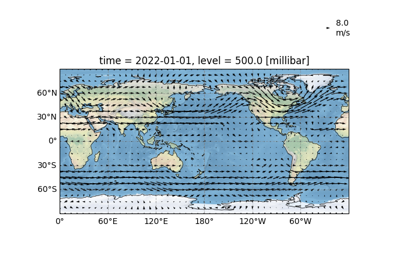
- easyclimate.field.ocean.calc_gradient(data_input: xarray.DataArray | xarray.Dataset, dim: str, varargs: int = 1, edge_order: int = 2) xarray.DataArray | xarray.Dataset
Compute the gradient along the coordinate dim direction.
The gradient is computed using second order accurate central differences in the interior points and either first or second order accurate one-sides (forward or backwards) differences at the boundaries. The returned gradient hence has the same shape as the input array.
Parameters
- data_input
xarray.DataArrayorxarray.Dataset. The spatio-temporal data to be calculated.
- dim
str. Dimension(s) over which to apply gradient. By default gradient is applied over the time dimension.
- varargs:
listof scalar or array, optional Spacing between f values. Default unitary spacing for all dimensions. Spacing can be specified using:
Single scalar to specify a sample distance for all dimensions.
N scalars to specify a constant sample distance for each dimension. i.e. \(\mathrm{d}x, \mathrm{d}y, \mathrm{d}z, ...\)
N arrays to specify the coordinates of the values along each dimension of F. The length of the array must match the size of the corresponding dimension.
Any combination of N scalars/arrays with the meaning of 2. and 3.
- edge_order: {1, 2}, optional
Gradient is calculated using N-th order accurate differences at the boundaries. Default: 2.
Returns
The gradient along the coordinate dim direction (
xarray.DataArrayorxarray.Dataset).See also
- data_input
- easyclimate.field.ocean.calc_seawater_thermocline_depth(seawater_temperature_data: xarray.DataArray, depth_dim: str = 'depth') xarray.DataArray
Caculate thermocline depth of ocean temperature.
Parameters
- seawater_temperature_data:
xarray.DataArray(\(\mathrm{^\circ C}\)). ocean temperature
xarray.DataArraydata to be calculated.- depth_dim:
str, default: depth. depth like dimension over which to apply calculate. By default extracting is applied over the depth dimension.
Returns
- seawater_temperature_data:
- easyclimate.field.ocean.calc_Dx_depth(seawater_temperature_data: xarray.DataArray, value: float, depth_dim: str = 'depth') xarray.DataArray
Caculate value depth of ocean temperature.
Parameters
- seawater_temperature_data:
xarray.DataArray(\(\mathrm{^\circ C}\)). ocean temperature
xarray.DataArraydata to be calculated.- value: float.
The depth of ocean temperature to be calculated.
- depth_dim:
str, default: depth. depth like dimension over which to apply calculate. By default extracting is applied over the depth dimension.
Returns
- seawater_temperature_data:
- easyclimate.field.ocean.calc_D14_depth(seawater_temperature_data: xarray.DataArray, value: float = 14, depth_dim: str = 'depth') xarray.DataArray
Caculate 14m depth of ocean temperature.
Parameters
- seawater_temperature_data:
xarray.DataArray(\(\mathrm{^\circ C}\)). ocean temperature
xarray.DataArraydata to be calculated.- value: float (\(\mathrm{m}\)).
The depth of ocean temperature to be calculated.
- depth_dim:
str, default: depth. depth like dimension over which to apply calculate. By default extracting is applied over the depth dimension.
Returns
- seawater_temperature_data:
- easyclimate.field.ocean.calc_D17_depth(seawater_temperature_data: xarray.DataArray, value: float = 17, depth_dim: str = 'depth') xarray.DataArray
Caculate 17m depth of ocean temperature.
Parameters
- seawater_temperature_data:
xarray.DataArray(\(\mathrm{^\circ C}\)). ocean temperature
xarray.DataArraydata to be calculated.- value: float (\(\mathrm{m}\)).
The depth of ocean temperature to be calculated.
- depth_dim:
str, default: depth. depth like dimension over which to apply calculate. By default extracting is applied over the depth dimension.
Returns
- seawater_temperature_data:
- easyclimate.field.ocean.calc_D20_depth(seawater_temperature_data: xarray.DataArray, value: float = 20, depth_dim: str = 'depth') xarray.DataArray
Caculate 20m depth of ocean temperature.
Parameters
- seawater_temperature_data:
xarray.DataArray(\(\mathrm{^\circ C}\)). ocean temperature
xarray.DataArraydata to be calculated.- value: float (\(\mathrm{m}\)).
The depth of ocean temperature to be calculated.
- depth_dim:
str, default: depth. depth like dimension over which to apply calculate. By default extracting is applied over the depth dimension.
Returns
- seawater_temperature_data:
- easyclimate.field.ocean.calc_D26_depth(seawater_temperature_data: xarray.DataArray, value: float = 26, depth_dim: str = 'depth') xarray.DataArray
Caculate 26m depth of ocean temperature.
Parameters
- seawater_temperature_data:
xarray.DataArray(\(\mathrm{^\circ C}\)). ocean temperature
xarray.DataArraydata to be calculated.- value: float (\(\mathrm{m}\)).
The depth of ocean temperature to be calculated.
- depth_dim:
str, default: depth. depth like dimension over which to apply calculate. By default extracting is applied over the depth dimension.
Returns
- seawater_temperature_data:
- easyclimate.field.ocean.calc_D28_depth(seawater_temperature_data: xarray.DataArray, value: float = 28, depth_dim: str = 'depth') xarray.DataArray
Caculate 28m depth of ocean temperature.
Parameters
- seawater_temperature_data:
xarray.DataArray(\(\mathrm{^\circ C}\)). ocean temperature
xarray.DataArraydata to be calculated.- value: float (\(\mathrm{m}\)).
The depth of ocean temperature to be calculated.
- depth_dim:
str, default: depth. depth like dimension over which to apply calculate. By default extracting is applied over the depth dimension.
Returns
- seawater_temperature_data: