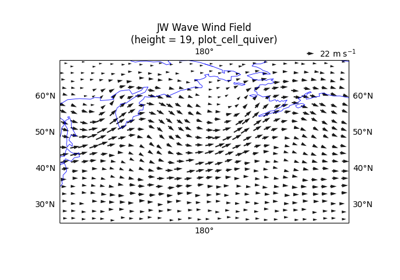
easyclimate.plot.icon.plot_cell_quiver
- easyclimate.plot.icon.plot_cell_quiver(ds, u_da, v_da, *, ax=None, lon_min=None, lon_max=None, lat_min=None, lat_max=None, center_lon=None, input_radians=True, lon_name_cell='clon', lat_name_cell='clat', nx_bins=35, ny_bins=20, thin_method='nearest_center', use_thinning_cache=True, add_quiverkey=True, quiverkey_value=None, quiverkey_label=None, quiverkey_x=0.88, quiverkey_y=1.04, transform=None, title=None, **quiver_kwargs)
Plot cell-centered vector wind on an ICON mesh.
ICON cell-centered vectors are thinned into regular longitude-latitude bins before they are passed to
Axes.quiver. This keeps vector density readable on native ICON triangular meshes.Parameters
- ds
xarray.Dataset ICON dataset containing cell coordinate variables.
- u_da, v_da
xarray.DataArrayornumpy.ndarray Cell-centered zonal/eastward and meridional/northward vector components. Each input must be one-dimensional on
ncellsafter selecting time or vertical dimensions.- ax
matplotlib.axes.Axes, optional Axes on which to draw. By default, use the current axes.
- lon_min, lon_max, lat_min, lat_max
float Plot extent in degrees. These bounds are required so vector thinning is restricted to the requested ICON domain.
- center_lon
float, optional Longitude center used for wrapping. If None, infer it from the extent or valid cell centers.
- input_radians
bool, default: True If True, ICON longitude and latitude variables are interpreted as radians and converted to degrees.
- lon_name_cell, lat_name_cell
str ICON cell coordinate variable names.
- nx_bins, ny_bins
int, default: 35, 20 Number of longitude and latitude bins used to thin vectors.
- thin_method{“nearest_center”, “max_speed”, “mean”}, default: “nearest_center”
Rule used to choose or aggregate one vector per bin.
- use_thinning_cache
bool, default: True If True, cache coordinate-only bin metadata for repeated calls on the same ICON mesh and extent.
- add_quiverkey
bool, default: True If True, add a reference quiver key.
- quiverkey_value
float, optional Reference vector magnitude for the quiver key. If None, use the 75th percentile of thinned vector speeds.
- quiverkey_label
str, optional Label for the quiver key. If None, build a metres-per-second label from
quiverkey_value.- quiverkey_x, quiverkey_y
float, default: 0.88, 1.04 Quiver-key position in axes coordinates.
- transform
cartopy.crs.CRS, optional Coordinate reference system of the input coordinates for Cartopy axes.
- title
str, optional Axes title. If None, use a default wind title.
- **quiver_kwargs
Additional keyword arguments passed to
Axes.quiver.
Returns
matplotlib.quiver.QuiverQuiver object returned by
Axes.quiver.
- ds