
easyclimate.physics.moisture.wet_bulb
Wet-bulb Temperature
Functions
|
Calculate wet-bulb potential temperature using iteration. |
Calculate wet-bulb potential temperature (\(\theta_w\)). |
|
Calculate wet-bulb potential temperature using Robert Davies-Jones (2008) approximation. |
|
|
Calculate wet-bulb temperature using Stull (2011) empirical formula. |
|
Calculate wet-bulb temperature using Sadeghi et. al (2011) empirical formula. |
Module Contents
- easyclimate.physics.moisture.wet_bulb.calc_wet_bulb_temperature_iteration(temperature_data: xarray.DataArray, relative_humidity_data: xarray.DataArray, pressure_data: xarray.DataArray, temperature_data_units: Literal['celsius', 'kelvin', 'fahrenheit'], relative_humidity_data_units: Literal['%', 'dimensionless'], pressure_data_units: Literal['hPa', 'Pa', 'mbar'], A: float = 0.662 * 10**-3, tolerance: float = 0.01, max_iter: int = 100, method: Literal['easyclimate-backend', 'easyclimate-rust'] = 'easyclimate-rust') xarray.DataArray
Calculate wet-bulb potential temperature using iteration.
The iterative formula
\[e = e_{tw} - AP(t-t_{w})\]\(e\) is the water vapor pressure
\(e_{tw}\) is the saturation water vapor pressure over a pure flat ice surface at wet-bulb temperature \(t_w\) (when the wet-bulb thermometer is frozen, this becomes the saturation vapor pressure over a pure flat ice surface)
\(A\) is the psychrometer constant
\(P\) is the sea-level pressure
\(t\) is the dry-bulb temperature
\(t_w\) is the wet-bulb temperature
Parameters
- temperature_data:
xarray.DataArray. Atmospheric temperature.
- relative_humidity_data:
xarray.DataArray. The relative humidity.
- pressure_data:
xarray.DataArray. The pressure data set.
- temperature_data_units:
str. The unit corresponding to temperature_data value. Optional values are celsius, kelvin, fahrenheit.
- relative_humidity_data_units:
str. The unit corresponding to vapor_pressure_data value. Optional values are
%,dimensionless.- pressure_data_units:
str. The unit corresponding to pressure_data value. Optional values are hPa, Pa, mbar.
- A:
float. Psychrometer coefficients.
Psychrometer Type and Ventilation Rate
Wet Bulb Unfrozen (10^-3/°C^-1)
Wet Bulb Frozen (10^-3/°C^-1)
Ventilated Psychrometer (2.5 m/s)
0.662
0.584
Spherical Psychrometer (0.4 m/s)
0.857
0.756
Cylindrical Psychrometer (0.4 m/s)
0.815
0.719
Chinese Spherical Psychrometer (0.8 m/s)
0.7949
0.7949
- tolerance:
float. Minimum acceptable deviation of the iterated value from the true value.
- max_iter:
int. Maximum number of iterations.
- method{“easyclimate-backend”,”easyclimate-rust”}
Backend implementation.
Returns
- tw:
xarray.DataArray( \(\mathrm{degC}\) ) Wet-bulb temperature
Examples
>>> import xarray as xr
>>> import numpy as np

# Create sample data
>>> temp = xr.DataArray(np.array([20, 25, 30]), dims=['point'])
>>> rh = xr.DataArray(np.array([50, 60, 70]), dims=['point'])
>>> pressure = xr.DataArray(np.array([1000, 950, 900]), dims=['point'])

# Calculate wet-bulb potential temperature
>>> theta_w = calc_wet_bulb_potential_temperature_iteration(
...     temperature_data=temp,
...     relative_humidity_data=rh,
...     pressure_data=pressure,
...     temperature_data_units="celsius",
...     relative_humidity_data_units="%",
...     pressure_data_units="hPa"
... )

# Example with 2D data
>>> temp_2d = xr.DataArray(np.random.rand(10, 10) * 30, dims=['lat', 'lon'])
>>> rh_2d = xr.DataArray(np.random.rand(10, 10) * 100, dims=['lat', 'lon'])
>>> pres_2d = xr.DataArray(np.random.rand(10, 10) * 200 + 800, dims=['lat', 'lon'])
>>> theta_w_2d = calc_wet_bulb_potential_temperature_iteration(
...     temp_2d, rh_2d, pres_2d, "celsius", "%", "hPa"
... )
See also
Fan, J. (1987). Determination of the Psychrometer Coefficient A of the WMO Reference Psychrometer by Comparison with a Standard Gravimetric Hygrometer. Journal of Atmospheric and Oceanic Technology, 4(1), 239-244. https://journals.ametsoc.org/view/journals/atot/4/1/1520-0426_1987_004_0239_dotpco_2_0_co_2.xml
Wang Haijun. (2011). Two Wet-Bulb Temperature Estimation Methods and Error Analysis. Meteorological Monthly (Chinese), 37(4): 497-502. website: http://qxqk.nmc.cn/html/2011/4/20110415.html
Cheng Zhi, Wu Biwen, Zhu Baolin, et al, (2011). Wet-Bulb Temperature Looping Iterative Scheme and Its Application. Meteorological Monthly (Chinese), 37(1): 112-115. website: http://qxqk.nmc.cn/html/2011/1/20110115.html
Example(s) related to the function
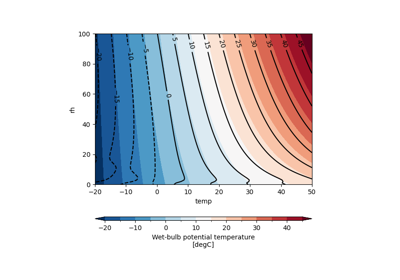
- easyclimate.physics.moisture.wet_bulb.calc_wet_bulb_potential_temperature_iteration(temperature_data: xarray.DataArray, relative_humidity_data: xarray.DataArray, pressure_data: xarray.DataArray, temperature_data_units: Literal['celsius', 'kelvin', 'fahrenheit', 'degC', 'degK'], relative_humidity_data_units: Literal['%', 'dimensionless'], pressure_data_units: Literal['hPa', 'Pa', 'mbar'], A: float = 0.000662, tolerance: float = 0.01, max_iter: int = 100, method: Literal['easyclimate-backend', 'easyclimate-rust'] = 'easyclimate-rust') xarray.DataArray
Calculate wet-bulb potential temperature (\(\theta_w\)).
The iterative formula for wet-bulb temperature
\[e = e_{tw} - AP(t-t_{w})\]\(e\) is the water vapor pressure
\(e_{tw}\) is the saturation water vapor pressure over a pure flat ice surface at wet-bulb temperature \(t_w\) (when the wet-bulb thermometer is frozen, this becomes the saturation vapor pressure over a pure flat ice surface)
\(A\) is the psychrometer constant
\(P\) is the sea-level pressure
\(t\) is the dry-bulb temperature
\(t_w\) is the wet-bulb temperature
Wet-bulb potential temperature (\(\theta_w\)) is defined as the temperature that an air parcel would have if it were first brought to saturation at its ambient pressure (i.e., cooled to the wet-bulb temperature, \(T_w\)), and then brought dry-adiabatically to a reference pressure, conventionally (\(p_0 = 1000 \mathrm{hPa}\)).
This quantity is therefore obtained from two steps:
Compute the wet-bulb temperature (\(T_w\)) at the parcel’s pressure (\(p\));
Apply the dry-adiabatic (Poisson) transformation from (\(p\)) to (\(p_0\)).
Under this definition, once (\(T_w\)) is known, (\(\theta_w\)) follows directly as
\[\theta_w = (T_w + 273.15) ( \frac{p_0}{p}) ^{\kappa} - 273.15\]where \(\kappa = \frac{R_d}{c_p} \approx 0.2854\), and \(p_0 = 1000 \mathrm{hPa}\).
This formulation makes clear that the iterative/nonlinear part of the calculation is confined to determining (\(T_w\)); the mapping from (\(T_w\)) to (\(\theta_w\)) is purely algebraic via the dry-adiabatic relation.
Parameters
- temperature_data:
xarray.DataArray. Atmospheric temperature.
- relative_humidity_data:
xarray.DataArray. The relative humidity.
- pressure_data:
xarray.DataArray. The pressure data set.
- temperature_data_units:
str. The unit corresponding to temperature_data value. Optional values are celsius, kelvin, fahrenheit.
- relative_humidity_data_units:
str. The unit corresponding to vapor_pressure_data value. Optional values are
%,dimensionless.- pressure_data_units:
str. The unit corresponding to pressure_data value. Optional values are hPa, Pa, mbar.
- A:
float. Psychrometer coefficients.
Psychrometer Type and Ventilation Rate
Wet Bulb Unfrozen (10^-3/°C^-1)
Wet Bulb Frozen (10^-3/°C^-1)
Ventilated Psychrometer (2.5 m/s)
0.662
0.584
Spherical Psychrometer (0.4 m/s)
0.857
0.756
Cylindrical Psychrometer (0.4 m/s)
0.815
0.719
Chinese Spherical Psychrometer (0.8 m/s)
0.7949
0.7949
- tolerance:
float. Minimum acceptable deviation of the iterated value from the true value.
- max_iter:
int. Maximum number of iterations.
- method{“easyclimate-backend”,”easyclimate-rust”}
Backend implementation.
Notes
\(\theta_w\) is obtained by first computing the wet-bulb temperature (Tw) and then reducing it dry-adiabatically to 1000 hPa.
- easyclimate.physics.moisture.wet_bulb.calc_wet_bulb_potential_temperature_davies_jones2008(pressure_data: xarray.DataArray, temperature_data: xarray.DataArray, dewpoint_data: xarray.DataArray, pressure_data_units: Literal['hPa', 'Pa', 'mbar'], temperature_data_units: Literal['celsius', 'kelvin', 'fahrenheit'], dewpoint_data_units: Literal['celsius', 'kelvin', 'fahrenheit']) xarray.DataArray
Calculate wet-bulb potential temperature using Robert Davies-Jones (2008) approximation.
Parameters
- pressure_data:
xarray.DataArray. The pressure data set.
- temperature_data:
xarray.DataArray. Atmospheric temperature.
- dewpoint_data:
xarray.DataArray. The dewpoint temperature.
- pressure_data_units:
str. The unit corresponding to pressure_data value. Optional values are hPa, Pa, mbar.
- temperature_data_units:
str. The unit corresponding to temperature_data value. Optional values are celsius, kelvin, fahrenheit.
- dewpoint_data_units:
str. The unit corresponding to dewpoint_data value. Optional values are celsius, kelvin, fahrenheit.
Returns
- tw:
xarray.DataArray( \(\mathrm{K}\) ) Wet-bulb temperature
See also
Davies-Jones, R. (2008). An Efficient and Accurate Method for Computing the Wet-Bulb Temperature along Pseudoadiabats. Monthly Weather Review, 136(7), 2764-2785. https://doi.org/10.1175/2007MWR2224.1
Knox, J. A., Nevius, D. S., & Knox, P. N. (2017). Two Simple and Accurate Approximations for Wet-Bulb Temperature in Moist Conditions, with Forecasting Applications. Bulletin of the American Meteorological Society, 98(9), 1897-1906. https://doi.org/10.1175/BAMS-D-16-0246.1
Example(s) related to the function
- pressure_data:
- easyclimate.physics.moisture.wet_bulb.calc_wet_bulb_temperature_stull2011(temperature_data: xarray.DataArray, relative_humidity_data: xarray.DataArray, temperature_data_units: Literal['celsius', 'kelvin', 'fahrenheit'], relative_humidity_data_units: Literal['%', 'dimensionless']) xarray.DataArray
Calculate wet-bulb temperature using Stull (2011) empirical formula.
\[T_{w} =T\operatorname{atan}[0.151977(\mathrm{RH} \% +8.313659)^{1/2}]+\operatorname{atan}(T+\mathrm{RH}\%)-\operatorname{atan}(\mathrm{RH} \% -1.676331) +0.00391838(\mathrm{RH}\%)^{3/2}\operatorname{atan}(0.023101\mathrm{RH}\%)-4.686035.\]Tip
This methodology was not valid for ambient conditions with low values of \(T_a\) (dry-bulb temperature; i.e., <10°C), and/or with low values of RH (5% < RH < 10%). The Stull methodology was also only valid at sea level.
Parameters
- temperature_data:
xarray.DataArray. Atmospheric temperature.
- relative_humidity_data:
xarray.DataArray. The relative humidity.
- temperature_data_units:
str. The unit corresponding to temperature_data value. Optional values are celsius, kelvin, fahrenheit.
- relative_humidity_data_units:
str. The unit corresponding to vapor_pressure_data value. Optional values are
%,dimensionless.
Returns
- tw:
xarray.DataArray( \(\mathrm{K}\) ) Wet-bulb temperature
See also
Stull, R. (2011). Wet-Bulb Temperature from Relative Humidity and Air Temperature. Journal of Applied Meteorology and Climatology, 50(11), 2267-2269. https://doi.org/10.1175/JAMC-D-11-0143.1
Stull, R. (2011): Meteorology for Scientists and Engineers. 3rd ed. Discount Textbooks, 924 pp. [Available online at https://www.eoas.ubc.ca/books/Practical_Meteorology/, https://www.eoas.ubc.ca/courses/atsc201/MSE3.html]
Knox, J. A., Nevius, D. S., & Knox, P. N. (2017). Two Simple and Accurate Approximations for Wet-Bulb Temperature in Moist Conditions, with Forecasting Applications. Bulletin of the American Meteorological Society, 98(9), 1897-1906. https://doi.org/10.1175/BAMS-D-16-0246.1
Example(s) related to the function
- temperature_data:
- easyclimate.physics.moisture.wet_bulb.calc_wet_bulb_temperature_sadeghi2013(temperature_data: xarray.DataArray, height_data: xarray.DataArray, relative_humidity_data: xarray.DataArray, temperature_data_units: Literal['celsius', 'kelvin', 'fahrenheit'], height_data_units: Literal['m', 'km'], relative_humidity_data_units: Literal['%', 'dimensionless']) xarray.DataArray
Calculate wet-bulb temperature using Sadeghi et. al (2011) empirical formula.
Parameters
- temperature_data:
xarray.DataArray. Atmospheric temperature.
- height_data:
xarray.DataArray. The elevation.
- relative_humidity_data:
xarray.DataArray. The relative humidity.
- temperature_data_units:
str. The unit corresponding to temperature_data value. Optional values are celsius, kelvin, fahrenheit.
- height_data_units:
str. The unit corresponding to height_data value. Optional values are m, km.
- relative_humidity_data_units:
str. The unit corresponding to vapor_pressure_data value. Optional values are
%,dimensionless.
Returns
- tw:
xarray.DataArray( \(\mathrm{degC}\) ) Wet-bulb temperature
See also
Sadeghi, S., Peters, T. R., Cobos, D. R., Loescher, H. W., & Campbell, C. S. (2013). Direct Calculation of Thermodynamic Wet-Bulb Temperature as a Function of Pressure and Elevation. Journal of Atmospheric and Oceanic Technology, 30(8), 1757-1765. https://doi.org/10.1175/JTECH-D-12-00191.1
Example(s) related to the function
- temperature_data: